Audit Committee Financial Expert: Qualifications Explained
An audit committee financial expert is a committee member whose background meets the SEC's competency test in accounting and financial reporting, and whose status is disclosed to investors each year rather than required of every company. Popular advice tells you to claim the label if you've held a senior finance title. That advice overlooks the critical test, because boards don't designate titles, they designate evidence that you can judge statements, estimates and controls at the company's own level of complexity.
Table of Contents
- What the Audit Committee Financial Expert Designation Means
- The Four Competencies Behind the Designation
- Misconceptions About Liability and Status
- Experience Routes That Qualify and How to Prove Them
- Three Candidate Profiles Tested Against the Rule
- Why Accounting Depth and Wider Risk Coverage Matter
- Confirm Your Fit Before Pursuing an Audit Committee Seat
What the Audit Committee Financial Expert Designation Means
Think of a flight crew where everyone can fly in clear weather, but one member is rated to read the complex instruments when conditions turn. An Audit Committee Financial Expert plays that role for financial reporting. The designation signals deeper accounting judgment, not a separate job on the board.
The concept became formal through Section 407 of the Sarbanes-Oxley Act of 2002, and the SEC final rules under Sections 406 and 407 of Sarbanes-Oxley were adopted on January 23, 2003. Those rules required companies subject to periodic reporting under the Securities Exchange Act of 1934, including domestic issuers, small-business issuers and foreign private issuers, to disclose annually whether at least one audit committee member qualified. Compliance applied to fiscal years ending on or after July 15, 2003, with small-business issuers following for fiscal years ending on or after December 15, 2003.
Disclosure Not a Universal Mandate
That distinction matters if you're exploring board of directors positions. A company could report that it had no expert, provided it explained why. The rule forced transparency while preserving flexibility in board composition.
When an expert does serve, the annual report must carry specific information:
- Named expert: The filing identifies the person who qualifies.
- Independence statement: It states whether that person is independent of management.
- Explanation if absent: If no expert serves, the company explains the reason.
Companies could also include the disclosure voluntarily in proxy materials and incorporate it by reference when permitted. The term is U.S.-rooted, so other regimes often use different competence and independence wording even when they pursue the same goal. If you can state the one sentence definition and explain that disclosure difference, you've grasped why the title exists.
The Four Competencies Behind the Designation
Read the designation as an evidence standard. A nomination committee is not checking whether you claim the title; it is checking whether you can document each attribute the rule names, because the committee's combined skills still have to match the risks it oversees.
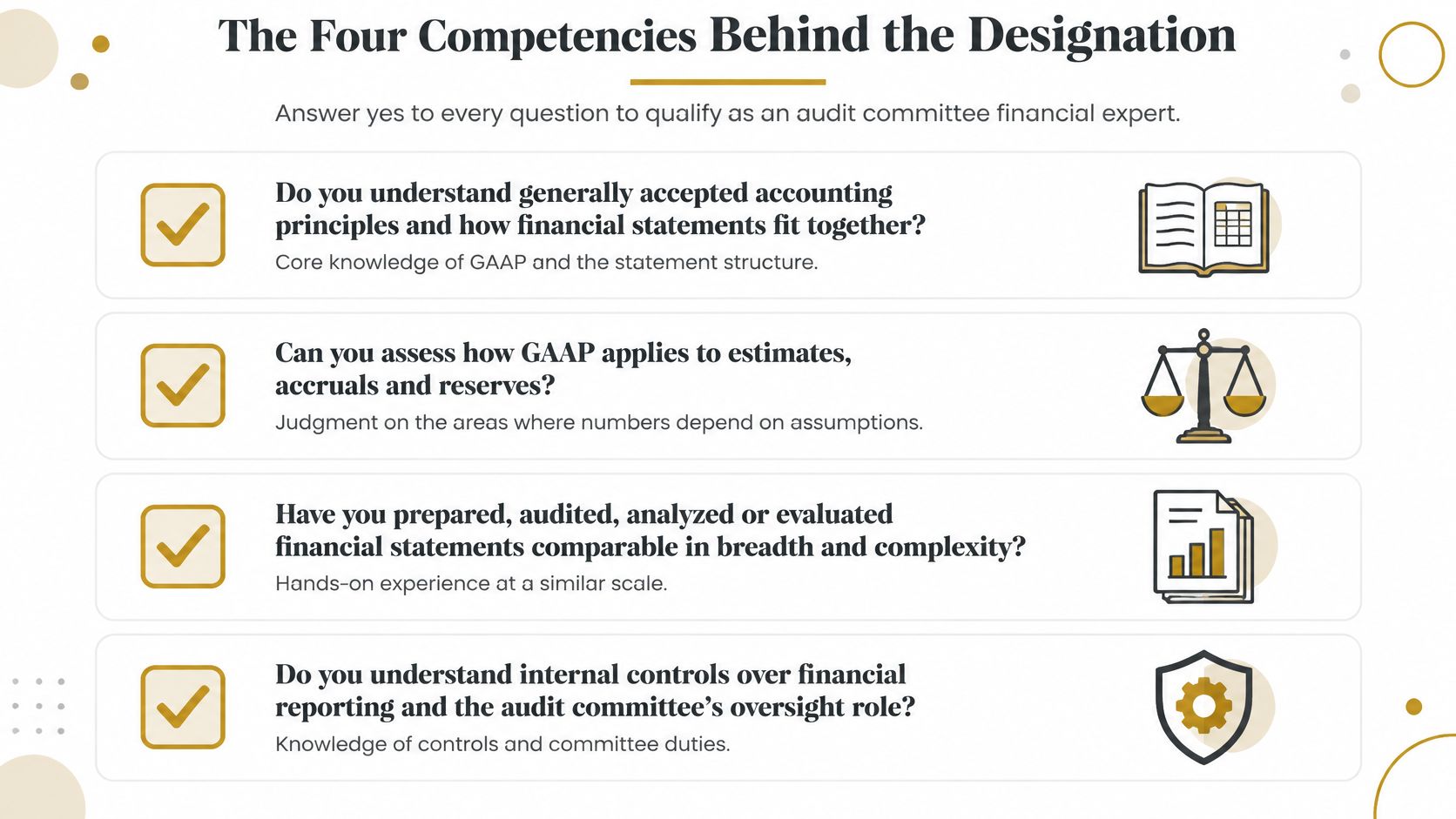
The SEC 2003 final rule defining the Audit Committee Financial Expert names five attributes. Four cover technical command of financial reporting and condense into the checklist below. The fifth, an understanding of audit committee functions, shows up in how well you grasp the oversight role itself, so treat these questions as a practical self-check rather than the complete official test.
- Do you understand GAAP and financial statements? You should know how the income statement, balance sheet and cash flow statement fit together, and where each can mislead.
- Can you assess estimates, accruals and reserves? These are the judgments where reported results can move without cash moving.
- Have you worked at comparable complexity? You have prepared, audited, analyzed or evaluated statements of similar breadth, or actively supervised people who did.
- Do you understand internal controls? That covers financial reporting procedures and how controls prevent or detect error.
What Comparable Complexity Means
A controller who consolidates subsidiaries across currencies, handles intercompany eliminations and defends impairment tests to auditors sits at one end of the range. A bookkeeper closing a single-site business with simple revenue sits at the other. Both work in accounting; only the first matches a complex listed issuer's reporting burden.
The test is therefore relative to the prospective company. It also doesn't limit eligibility to certified public accountants or former chief financial officers, because attributes can come from service as a principal financial officer, principal accounting officer, controller, public accountant, auditor or someone performing similar functions. Many audit committees already report finance and accounting expertise among their members, so designation turns on documented evidence across the attributes, not on the scarcity of qualified people.
This short briefing helps you hear the four questions as a board would phrase them.
Run this self-test before you draft anything with a board bio builder. In two minutes, explain why a change in a warranty reserve moved earnings and name the control that should have caught a weak assumption. If you can't, you've found your gap, and a gap you can name is easier to close than one a committee names for you.
Misconceptions About Liability and Status
The fear usually arrives before the evidence does. A capable finance executive hears "financial expert" and pictures personal liability for every figure, then either avoids audit committees or talks down years of relevant work.
The SEC's 2003 final rule drew the boundary plainly: being identified as the audit committee financial expert does not make that director an "expert" for other purposes, does not add duties or liability, and does not reduce the obligations of other members. Treat that as a limit on mythology, not a reason to relax. The designation is an evidence standard for one disclosed role and a signal about how the whole committee's skills match the issuer's risks.
Four Myths to Clear Early
- Designation adds personal liability: it does not create a separate fiduciary tier. Still confirm D&O coverage, indemnification and disclosure wording with counsel before you accept.
- Only CPAs or former CFOs qualify: controller, auditor, supervisory and oversight routes can count when the work matches the issuer's complexity. Name the route plainly.
- A finance title is enough: boards look for dated evidence around reserves, estimates, controls and auditor challenge, not a business card.
- One expert covers everyone: each member keeps their own obligations, so the committee still needs a skills map rather than a single designated shield.
Treat the designation as a selection signal and a disclosure fact, never as armor or as a reason for the rest of the committee to stop challenging.
Keep three ideas separate. Financial literacy lets every member read the statements. Listing-rule financial sophistication is an exchange expectation. The SEC designation is the specific disclosed classification, most directly relevant to U.S.-listed and cross-listed issuers; Canadian, UK, EU, Australian and Singaporean regimes may use different concepts.
The practical task is documentation. Decide which route you rely on, which judgments you can evidence, and how the disclosure should read, then test that package with the chair, counsel and the D&O insurer before acceptance.
Experience Routes That Qualify and How to Prove Them
A route is where you gained the attributes, not the label on your business card. The SEC rule text on qualifying experience for an Audit Committee Financial Expert focuses on understanding GAAP and statements, evaluating estimates, accruals and reserves, and working with statements of comparable breadth and complexity, including through direct supervision.
Experience Routes and What They Need to Qualify
| Experience route | Qualifies? | Evidence to document |
|---|---|---|
| Principal financial officer (CFO) | Yes | Signed filings, audit committee reporting, restatement handling |
| Principal accounting officer or controller | Yes | Close process ownership, significant accounting policies, audit adjustments |
| Public accountant or auditor | Yes | Audit engagements, testing of complex estimates, issued opinions |
| Direct supervisor of people preparing or auditing statements | Yes, if the work was comparable in complexity | Team size, reserve and valuation sign-offs |
| Oversight of companies or public accountants in statement work | May qualify | Audit committee service, review of auditor reports and findings |
| Banking, treasury or deal work | Only if the role evaluated the issuer's financial statements | Statement-level judgments, not deal valuation alone |
| General finance or fund management | Only if statement evaluation was part of the role | Documented review of reporting, reserves and controls |
Turning a Route Into Evidence
Banking, treasury or deal experience doesn't fail automatically. It fails when your file shows pricing, funding or transaction judgment but no evaluation of an issuer's statements. The same applies to general finance, where reviewing results isn't the same as testing the accounting behind them.
Document specific exposure instead of writing "finance" or "audit" in a biography. Boards look for material estimates, valuation judgments, reserves, revenue recognition, consolidation, impairment and complex disclosures. Controls matter too, so include control design, remediation and management and auditor interactions.
Illustrative evidence line: Led the year-end reserve review for a large receivables book, handled two audit adjustments and redesigned the related control.
Adapt that pattern with your own facts, dates and outcomes. Add proof such as remediation of a material weakness, negotiation with the external auditor over a policy, or reporting a deficiency to an audit committee. Then test whether the wording would survive a board CV grader review for vagueness.
Build a one-page evidence file that maps each qualifying route to documents, dates and complexity. If a claim has no document or referee behind it, soften it or remove it before a board, insurer or regulator asks.
Three Candidate Profiles Tested Against the Rule
Examples make the boundary clearer than definitions. These four profiles are illustrative, not real candidates, and each verdict depends on evidence rather than reputation.
Illustrative Candidate Profiles Scored Against the Test
| Profile | Experience | Designation fit | Gap to close |
|---|---|---|---|
| Former controller of a listed manufacturer | Twelve years of closing books, reserve judgments and restatement response | Strong | Document committee-facing reporting |
| Private equity operating partner | Deal valuation and oversight of portfolio company accounts | Partial | Show statement-level review, not deal valuation alone |
| Retired audit partner | Opinions on mid-cap issuers across a long career | Strong on substance | Clear auditor-independence cooling-off rules first |
| Cyber-risk officer with finance background | IT controls and technology-risk reporting | Weak for the designation | Add accounting evidence or present as adjacent value |
The controller is strongest because the work sits inside audited reporting. Twelve years alone isn't the point, the reserve judgments and restatement response are. Adding examples of presenting to an audit committee would turn technical depth into boardroom evidence.
The private equity partner is the common borderline case. Portfolio oversight can qualify when minutes and memos show review of accounting policies, reserves and auditor findings. If the record only shows entry multiples and exit value, a board using a board role fit checklist should mark designation fit as partial.
A retired audit partner brings deep statement judgment, but independence cooling-off rules can delay or block appointment to a former audit client. The cyber-risk officer reverses the problem, they're valuable for technology controls yet weak for this designation until accounting evidence exists.
Keep the Exchange Test Separate
For NYSE-listed companies, the NYSE audit committee rule on accounting or related financial management expertise requires at least one member to have that expertise, interpreted through the board's business judgment. That's a committee composition requirement, while the SEC framework defines attributes for disclosure. A candidate might satisfy the exchange expectation even where SEC designation remains unclear, so don't merge the two tests.
Why Accounting Depth and Wider Risk Coverage Matter
Not all financial experience improves oversight in the same way. A banker can judge capital structure, an investor can judge valuation, and an accounting expert can judge whether the reported profit rests on defensible estimates. Audit committees need that third skill most when numbers depend on assumptions.
A meta-analysis of audit committee expertise and earnings quality found financial expertise is positively associated with earnings quality, with accounting experts showing a stronger relationship than non-accounting financial experts. The reason is practical, accounting experts are better positioned to challenge estimates, accruals, reserves, revenue recognition and disclosure judgments, then translate concerns into focused questions for the external auditor and internal audit.
Think of a hospital review board. A general physician adds value, but a specialist in the condition under review spots the subtle chart error others pass over. Accounting depth works the same way when a reserve release flatters a quarter or revenue is recognized before delivery is complete.
Questions That Show Accounting Depth
- Which estimate moves most? Ask which result would change materially if a key assumption moved by ten percent.
- What supports revenue cut-off? Ask for evidence around quarter-end shipments, acceptance and collectability.
- Where was internal audit overruled? Ask where management rejected a finding and what changed afterward.
Screening should separate accounting expertise from investment, banking or general corporate finance experience. Test comparable reporting complexity through audited filings, internal control deficiencies, audit adjustments, significant policies, restatements and audit committee reporting. If a candidate can't discuss those items in concrete terms, a generic financial label shouldn't carry the appointment.
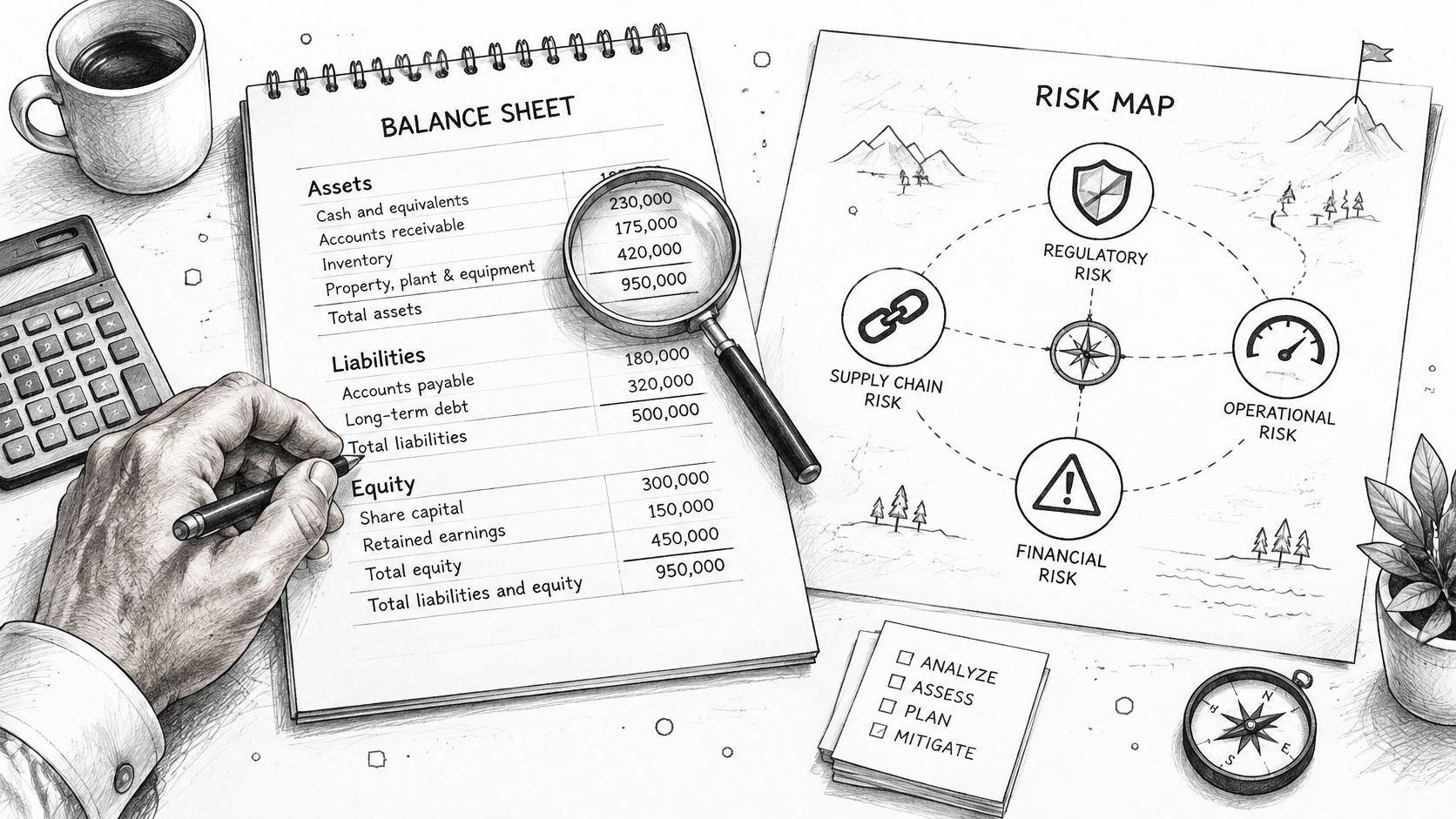
This image captures the shift from reviewing statements alone to mapping them against a broader risk picture.
Where the Financial Label Is Too Narrow
A global KPMG survey conducted in 2025 on audit committee composition found 62% of respondents had at least some concerns about audit committee composition or skill sets, and cybersecurity technology expertise was the leading concern, cited by 33% of those expressing concern. That mismatch explains why a committee can satisfy disclosure and still struggle with its actual workload.
Modern gaps include cyber incidents, technology controls, data governance, AI-related reporting risks, digital transformation and sustainability assurance. For example, a ransomware incident can affect revenue systems, internal controls and disclosure timing at once. An accounting expert can test the financial consequences, but the committee also needs someone who understands whether technology controls were designed and operating properly.
Present adjacent technology or sustainability experience as committee value, never as proof that it independently meets the SEC financial expert test.
Use a two-dimensional profile instead. First, document the accounting and financial reporting evidence supporting eligibility. Second, list emerging-risk capabilities separately, such as oversight of technology controls, cyber-risk reporting or assurance over sustainability information. That honesty helps boards map the whole committee against its risks, and it makes your accounting claim more credible because you haven't inflated everything else into it.
Confirm Your Fit Before Pursuing an Audit Committee Seat
Don't start by searching for vacancies. Start by deciding whether your evidence supports the designation itself, an adjacent committee seat, or another period of preparation first.
The designation is an evidence standard, not a title, and it only carries weight when the committee's wider skills cover the issuer's risks. The five checks below turn that into a sequence you can finish before approaching a chair.
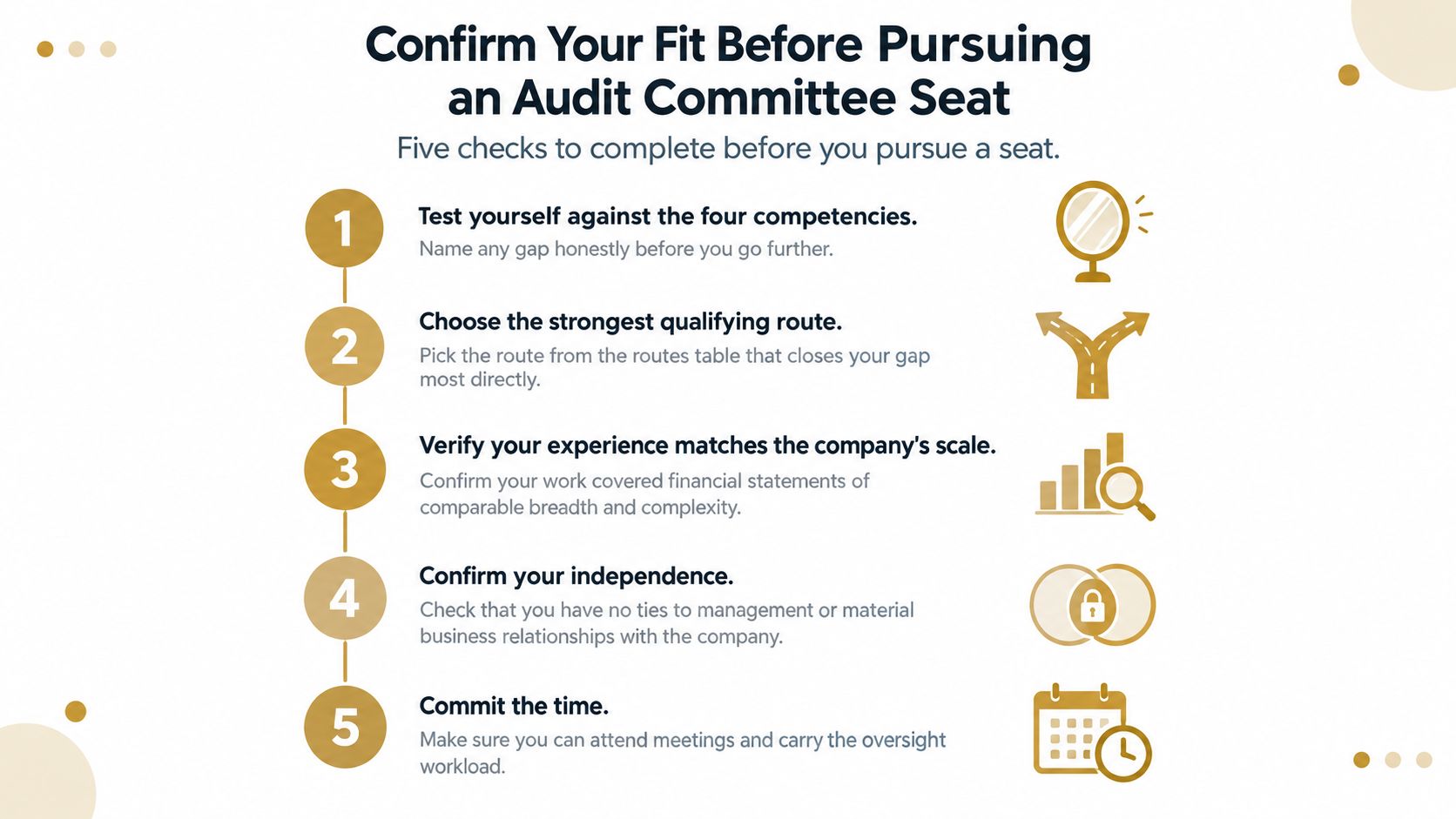
- Test the four competencies: Answer each question against dated documents and name any gap openly; a board readiness assessment gives you a structure for doing this rigorously.
- Choose your strongest route: Pick the qualifying pathway you can prove, not the most senior-sounding title.
- Match the board type: Check whether a listed company needs a disclosable expert or an unlisted board needs broader risk coverage.
- Clear independence checks: Review former employers, audit relationships, investments and conflicts before discussions advance.
- Build the two-part profile: Keep designation evidence separate from emerging-risk capabilities so neither claim weakens the other.
Each check produces something you can show a chair rather than a judgment you keep in your head.
For candidates who want outside help, SeatSignal runs a done-for-you board placement program. During onboarding you share your sectors, expertise, committee interests, board readiness, and whether you are open to paid, unpaid, equity, or honorarium roles. Those answers matter because audit committee suitability turns on the issuer's reporting risks, not on seniority alone. Every plan includes hand-picked board roles checked by a person, pre-public seat matching across every sector, warm-path introductions when available, a director-grade packet for each board (a CV, a cover letter written to the charter and its gap, a fit memo, an independence attestation), board-specific interview preparation, and a placement team reviewing what reaches you. The rehearsal targets the questions that board's chair is most likely to ask, drawn from the role, the committee and the gaps found in that boardroom.
Treat that support as one option, not a promise. Boards, nomination committees and recruiters make appointment decisions, so no service can secure you a seat, and you remain responsible for reviewing, fact-checking and editing every AI-generated document before it is submitted.
Complete the five checks, assemble the evidence file, then pursue the audit committee seat that matches what you can document.
If your file shows you are ready, SeatSignal can hand-pick board matches, prepare a director-grade packet for each role, and rehearse you for the chair and committee questions you are likely to face.
Want a paid board role, done for you?
One handpicked, verified open board role every week, with a director-grade packet tailored for it.
Get Started